
IWTT · A decade of opening possibilities
Building India’s Tennis Future
From the Will to Play to Competency on the World Stage
By CA Sunil Jain · Founder, Indian Wheelchair Tennis Tour and DEUCE Tennis Center
Who does not have the will to play?
A child wants to explore. A young person wants to test their ability. An adult may want to learn, compete or experience the joy of movement. Across ages and abilities, play offers a way to express ourselves and discover what we can become.
For that expression, we need spaces in which we can move at will.
When India puts tennis at the centre, every stakeholder has a reason to move. Players practise and compete. Coaches develop their ability to enable learning. Families make choices about their participation. Associations organise competition. Communities create places to play. Businesses, public institutions and professionals bring resources and expertise.
No single stakeholder gives another the entire opportunity. Together, through our choices and actions, we create an ecosystem in which tennis can grow and each of us can participate in that growth.
This is the possibility we call democratizing movement.
What the court teaches us
On a tennis court, the ball is always moving. A player observes, decides, moves and responds. Sometimes the player reaches the ball; sometimes they miss. Each attempt provides information for the next one.
The same is true in life. We live with aspirations, make choices, encounter circumstances, learn and move again. The court gives us a place to practise this process with attention and purpose.
In my understanding, the will of the people is connected to the promise of the Constitution of India. Those who shape and administer our institutions have a responsibility to facilitate the expression of that will. When a person is unable to move, play and participate, I believe we must ask what that deprivation means for their experience of the right to life.
A nation that is not sufficiently invested in enabling play risks weakening its confidence in its own possibilities. A nation that makes room for its people to play has more space to build capability, connection and confidence.
From aspiration to architecture
India has the ambition to establish itself on the world tennis stage. That ambition deserves an architecture strong enough to support it.
For too long, we have often looked at a player’s ranking or tournament result as the primary measure of progress. Those results matter. But they do not, by themselves, tell us how consistently a player has practised, what learning has taken place or whether the wider ecosystem is becoming more capable of supporting the journey.
At DEUCE Tennis Center, we propose a question: How do we measure the competency that India is building through tennis?
- Court hours per playerHow much time is a player spending on court in consistent play, practice and training?
- Domestic national ranking pointsHow is that participation contributing to the player’s experience and results in recognised national competition?
We call the larger possibility National Tennis Competency Capital: the collective capacity that India develops through its players, coaches, playing spaces, competitions and supporting services.
Court hours and domestic ranking points can give us a starting point for understanding that capacity. They can help us ask better questions about access, continuity, training and competition.
Court hours alone do not establish the quality of practice, just as ranking points alone do not describe a player’s entire development. Their value lies in examining them together, alongside the experiences of players and coaches, the quality of training and the resources available to sustain participation.
With such an architecture, we can begin to understand where investment is helping players develop, where barriers remain and what the ecosystem needs next. Without a way to observe and learn from the journey, our aspiration to place Indian tennis on the world map is harder to pursue systematically—and harder for every stakeholder to contribute to meaningfully.
The economics of movement
For a player, participation begins before reaching the court. There is the cost of travel, accommodation, food, local transportation, equipment and training. There is also the time invested by players, families, coaches, organisers and supporters.
These are not merely logistical matters. They are part of the economics of movement and play.
Players in both wheelchair and other forms of tennis may spend substantial amounts travelling and competing internationally in pursuit of world ranking points. At the national level, questions arise about daily allowances, prize money and the costs players must carry themselves.
We need to examine these questions in relation to the journey we want players to undertake. If consistent court time and competition are necessary to develop competency, how do we organise resources so that players can sustain that journey? How do we strengthen domestic competition while also preparing players for international play?
These questions invite participation from the whole ecosystem. They call for information, dialogue and a willingness to examine how our present practices serve our shared aspirations.
What ten years of IWTT has made possible
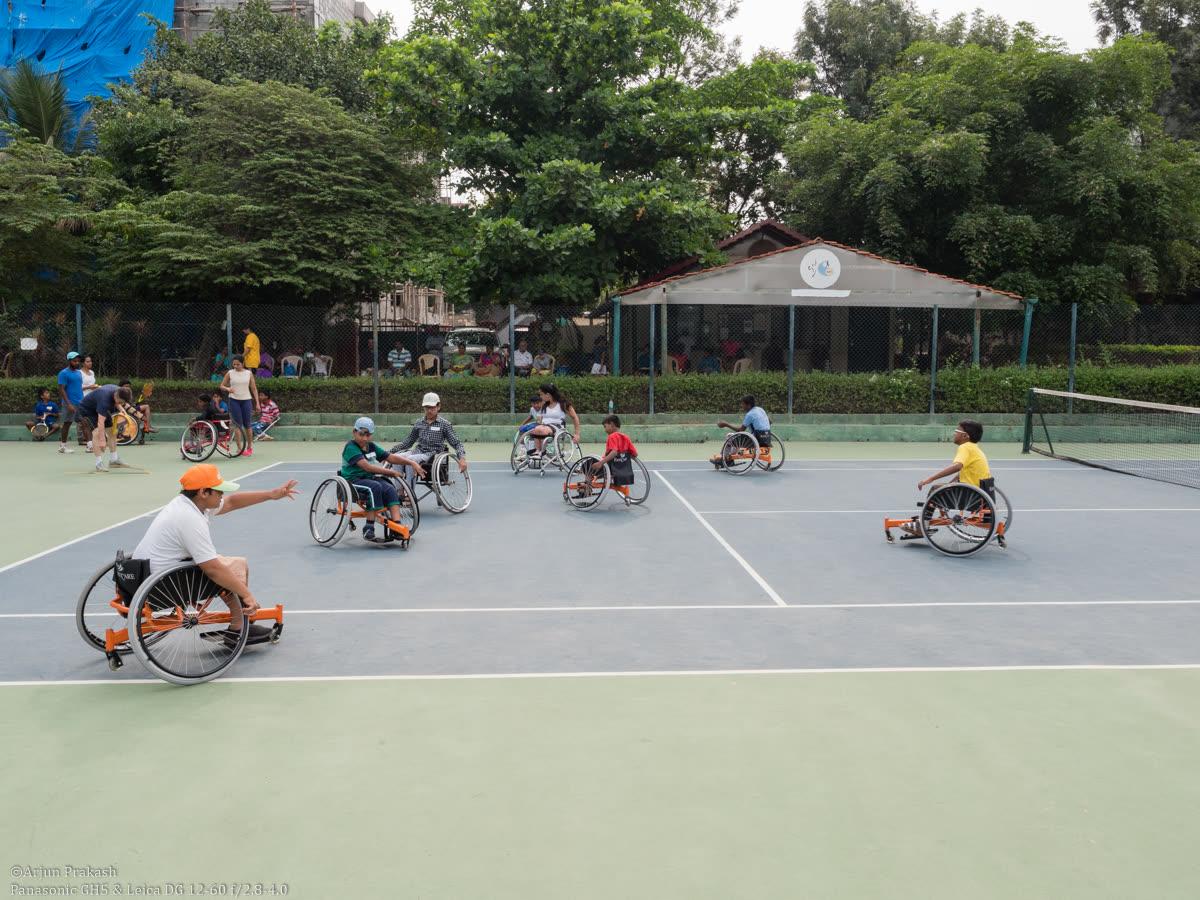
When NGO Astha began the Indian Wheelchair Tennis Tour in 2016, we wanted to create a space where players could play, compete and express their aspirations.
From the beginning, our intention extended beyond charity. The charitable legal structure helped us begin and receive the support needed to build. The larger work has been to create an ecosystem in which players and every other stakeholder can participate in a sporting journey that creates value for all.
Over the past decade, players, coaches, volunteers, donors, corporate partners, families and institutions have contributed to tournaments, training, advocacy and the development of playing spaces. Their efforts have helped establish national competition pathways and have brought us to the creation of DEUCE Tennis Center.
The financial support of donors and CSR partners has been essential. Raising those resources has also required sustained work: building relationships and trust, communicating the purpose, organising activities and accounting for the support received.
Alongside this work, we have encouraged players to explore how they can earn, build their own support systems and approach the institutions whose mandate includes developing and promoting sport. The intention has been to strengthen the ability of players and their families to choose and shape their own journeys.
The ecosystem created over these ten years gives us an opportunity to ask a deeper question: What place do movement and play have in our lives, and what are we willing to do to make them part of our journey?
Support that strengthens agency
Democratizing movement does not mean that everything must be provided to a player. When an institution or individual takes over every aspect of someone else’s journey, it can leave less room for that person to choose, act and develop confidence in their own capacity.
The starting point is the person’s willingness to play and their choice to take on a journey. The ecosystem’s role is to make space for that choice—to organise access to play, learning, competition, information and the services that support participation.
Support may be financial. It may also take the form of coaching, accessible facilities, transport, knowledge, professional services or a connection to the right person. Players and families have different circumstances, so there will be different kinds of support needed. The question is how each contribution can strengthen a person’s ability to participate in their own journey.
A new practice at Tabebuia Open 2026
At Tabebuia Open 2026, we are taking a step in this direction.
We are moving away from financing players’ accommodation, food and local transportation as a standard arrangement. At the same time, we recognise that organising these services individually can be difficult, particularly when a player is travelling with sporting equipment to an unfamiliar place.
The organising team is therefore investing its effort in bringing these services together as an optional, concessional package at ₹750 per player per day, covering shared accommodation, specified meals and local transportation. Players can choose whether they wish to use it.
We see this as a practice from which the entire ecosystem can learn. It allows us to ask how players, organisers, local communities, businesses, institutions and supporters can each contribute to making a tournament work.
It also invites us to look beyond a single event. Every additional hour of play, every conversation with a coach and every experience of competition can become part of a player’s continuing journey. If we observe and understand that journey, we can make better decisions about where to invest our collective efforts.
Feeding the next ball
On court, it is the player who moves towards the ball and plays it. A coach or fellow player can feed a ball in a way that enables the player to practise a movement that is not yet within reach. With repeated play and learning, the player develops the ability to respond. Then there is another ball to play.
This is how I see the role of the ecosystem. Our work is to create the conditions, relationships and practices through which people can take on what matters to them and develop the competency to move forward.
Being competitive begins with becoming competent.
Competency is developed through consistent play, practice, reflection, learning and competition. It is strengthened when the ecosystem pays attention to the player’s journey and when the player chooses to participate in that journey.
Advantage Tennis. Advantage India.
At DEUCE Tennis Center, we speak of Advantage Tennis. We put tennis at the centre so that every stakeholder can ask: What is the game making possible for me, and what can I contribute to the game?
When tennis is at the centre, our work is connected. A coach’s learning supports a player’s practice. A player’s commitment gives meaning to competition. A tournament creates work for officials, medical professionals, photographers, transport providers and local businesses. A community that makes space for play creates possibilities for its children and future generations.
As we celebrate a decade of opening possibilities, our next aspiration is to bring world-ranking wheelchair tennis tournaments to India and to strengthen the grassroots, training and competitive pathways that prepare players for the world stage.
At Tabebuia Open 2026, we invite every stakeholder in Indian tennis to join us in imagining and creating this future:
A future where tennis is adorable, affordable and accessible for all—with no one left out.
Let us put tennis at the centre, measure the competency we are building, and move together towards what the game can offer each of us.
Same Game. Same Passion. Advantage Tennis. Advantage India.
— CA Sunil Jain, Founder, Indian Wheelchair Tennis Tour and DEUCE Tennis Center